


Page 57 - Adobe Photoshop and Dreamviewer 2021
P. 57
Understanding Channels

             You need a bit of background about channels to understand what’s happening in the Quick Mask you will use in the next
             exercise. (You will use channels extensively in later projects.)
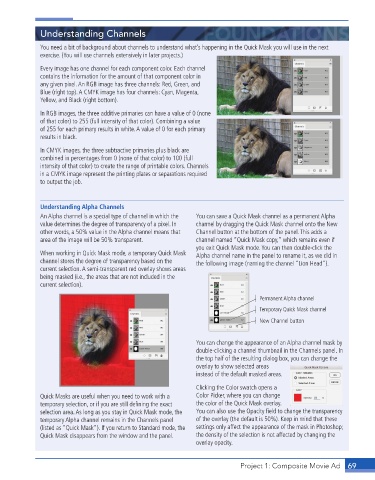
             Every image has one channel for each component color. Each channel
             contains the information for the amount of that component color in
             any given pixel. An RGB image has three channels: Red, Green, and
             Blue (right top). A CMYK image has four channels: Cyan, Magenta,
             Yellow, and Black (right bottom).

             In RGB images, the three additive primaries can have a value of 0 (none
             of that color) to 255 (full intensity of that color). Combining a value
             of 255 for each primary results in white. A value of 0 for each primary
             results in black.

             In CMYK images, the three subtractive primaries plus black are
             combined in percentages from 0 (none of that color) to 100 (full
             intensity of that color) to create the range of printable colors. Channels
             in a CMYK image represent the printing plates or separations required
             to output the job.


             Understanding Alpha Channels
             An Alpha channel is a special type of channel in which the   You can save a Quick Mask channel as a permanent Alpha
             value determines the degree of transparency of a pixel. In   channel by dragging the Quick Mask channel onto the New
             other words, a 50% value in the Alpha channel means that   Channel button at the bottom of the panel. This adds a
             area of the image will be 50% transparent.      channel named “Quick Mask copy,” which remains even if
                                                             you exit Quick Mask mode. You can then double-click the
             When working in Quick Mask mode, a temporary Quick Mask   Alpha channel name in the panel to rename it, as we did in
             channel stores the degree of transparency based on the   the following image (naming the channel “Lion Head”).
             current selection. A semi-transparent red overlay shows areas
             being masked (i.e., the areas that are not included in the
             current selection).
                                                                                Permanent Alpha channel
                                                                                Temporary Quick Mask channel
                                                                                New Channel button


                                                             You can change the appearance of an Alpha channel mask by
                                                             double-clicking a channel thumbnail in the Channels panel. In
                                                             the top half of the resulting dialog box, you can change the
                                                             overlay to show selected areas
                                                             instead of the default masked areas.

                                                             Clicking the Color swatch opens a
             Quick Masks are useful when you need to work with a   Color Picker, where you can change
             temporary selection, or if you are still defi ning the exact   the color of the Quick Mask overlay.
             selection area. As long as you stay in Quick Mask mode, the   You can also use the Opacity fi eld to change the transparency
             temporary Alpha channel remains in the Channels panel   of the overlay (the default is 50%). Keep in mind that these
             (listed as “Quick Mask”). If you return to Standard mode, the   settings only affect the appearance of the mask in Photoshop;
             Quick Mask disappears from the window and the panel.  the density of the selection is not affected by changing the
                                                             overlay opacity.


                                                                          Project 1: Composite Movie Ad    69

