


Page 43 - CC2018_ID_Look_Inside
P. 43
More about Working with InDesign Objects
                   Transforming Objects Manually
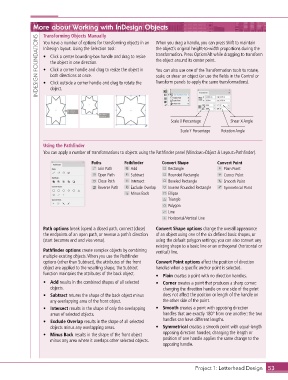
                 INDESIGN FOUNDATIONS  InDesign layout. Using the Selection tool:  the object’s original height-to-width proportions during the
                                                                 When you drag a handle, you can press Shift to maintain
                   You have a number of options for transforming objects in an
                                                                 transformation. Press Option/Alt while dragging to transform
                   •  Click a center bounding-box handle and drag to resize
                                                                 the object around its center point.
                      the object in one direction.
                   •  Click a corner handle and drag to resize the object in
                                                                 You can also use one of the Transformation tools to rotate,
                      both directions at once.
                                                                 scale, or shear an object (or use the fields in the Control or
                                                                 Transform panels to apply the same transformations).
                   •  Click outside a corner handle and drag to rotate the
                      object.


                                                                       Scale X Percentage       Shear X Angle

                                                                            Scale Y Percentage  Rotation Angle


                   Using the Pathfinder
                   You can apply a number of transformations to objects using the Pathfinder panel (Window>Object & Layout>Pathfinder).

                                       Paths        Pathfinder      Convert Shape          Convert Point
                                         Join Path     Add            Rectangle              Plain Point
                                         Open Path     Subtract       Rounded Rectangle      Corner Point
                                         Close Path    Intersect      Beveled Rectangle      Smooth Point
                                         Reverse Path  Exclude Overlap  Inverse Rounded Rectangle  Symmetrical Point
                                                       Minus Back     Ellipse
                                                                      Triangle
                                                                      Polygon
                                                                      Line
                                                                      Horizontal/Vertical Line
                   Path options break (open) a closed path, connect (close)   Convert Shape options change the overall appearance
                   the endpoints of an open path, or reverse a path’s direction   of an object using one of the six defined basic shapes, or
                   (start becomes end and vice versa).           using the default polygon settings; you can also convert any
                                                                 existing shape to a basic line or an orthogonal (horizontal or
                   Pathfinder options create complex objects by combining   vertical) line.
                   multiple existing objects. When you use the Pathfinder
                   options (other than Subtract), the attributes of the front   Convert Point options affect the position of direction
                   object are applied to the resulting shape; the Subtract   handles when a specific anchor point is selected.
                   function maintains the attributes of the back object.  •  Plain creates a point with no direction handles.
                   •  Add results in the combined shapes of all selected   •  Corner creates a point that produces a sharp corner;
                      objects.                                      changing the direction handle on one side of the point
                   •  Subtract returns the shape of the back object minus   does not affect the position or length of the handle on
                      any overlapping area of the front object.     the other side of the point.
                   •  Intersect results in the shape of only the overlapping   •  Smooth creates a point with opposing direction
                      areas of selected objects.                    handles that are exactly 180° from one another; the two
                   •  Exclude Overlap results in the shape of all selected   handles can have different lengths.
                      objects minus any overlapping areas.       •  Symmetrical creates a smooth point with equal-length
                   •  Minus Back results in the shape of the front object   opposing direction handles; changing the length or
                      minus any area where it overlaps other selected objects.  position of one handle applies the same change to the
                                                                    opposing handle.


                                                                                  Project 1: Letterhead Design  53

