


Page 24 - CC2018_ID_Look_Inside
P. 24
The Control Panel in Depth                         Finally, it is customizable, which means you can change the
               The Control panel is one of the most versatile, productive
             INDESIGN FOUNDATIONS  common formatting options into a single, compact format.   to note that the options available in the Control panel might
               tools in the InDesign workspace, combining all of the most
                                                              options that are available in the panel. (It is also important
                                                              be limited by the active workspace, as well as by the width
               It is context sensitive, which means different options are
               available depending on what is selected in the layout.
                                                              of your monitor or Application frame.)
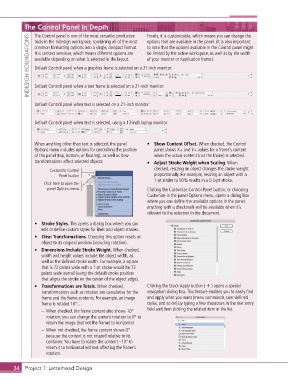
               Default Control panel when a graphics frame is selected on a 21-inch monitor:


               Default Control panel when a text frame is selected on a 21-inch monitor:


               Default Control panel when text is selected on a 21-inch monitor:


               Default Control panel when text is selected, using a 13-inch laptop monitor:


               When anything other than text is selected, the panel   •  Show Content Offset. When checked, the Control
               Options menu includes options for controlling the position   panel shows X+ and Y+ values for a frame’s content
               of the panel (top, bottom, or floating), as well as how   when the actual content (not the frame) is selected.
               transformations affect selected objects:       •  Adjust Stroke Weight when Scaling. When
                      Customize Control                          checked, resizing an object changes the stroke weight
                         Panel button                            proportionally. For example, resizing an object with a
                                                                 1-pt stroke to 50% results in a 0.5-pt stroke.
                   Click here to open the
                    panel Options menu.                       Clicking the Customize Control Panel button, or choosing
                                                              Customize in the panel Options menu, opens a dialog box
                                                              where you can define the available options in the panel;
                                                              anything with a checkmark will be available when it’s
                                                              relevant to the selection in the document.

               •  Stroke Styles. This opens a dialog box where you can
                  edit or define custom styles for lines and object strokes.
               •  Clear Transformations. Choosing this option resets an
                  object to its original position (including rotation).
               •  Dimensions Include Stroke Weight. When checked,
                  width and height values include the object width, as
                  well as the defined stroke width. For example, a square
                  that is 72 points wide with a 1-pt stroke would be 73
                  points wide overall (using the default stroke position
                  that aligns the stroke on the center of the object edge).
               •  Transformations are Totals. When checked,   Clicking the Quick Apply button (  ) opens a special
                  transformations such as rotation are cumulative for the   navigation dialog box. This feature enables you to easily find
                  frame and the frame contents. For example, an image   and apply what you want (menu commands, user-defined
                  frame is rotated 10°…                       styles, and so on) by typing a few characters in the text entry
                  –   When checked, the frame content also shows 10°   field and then clicking the related item in the list.
                    rotation; you can change the content rotation to 0° to
                    return the image (but not the frame) to horizontal.
                  –    When not checked, the frame content shows 0°
                    because the content is not rotated relative to its
                    container. You have to rotate the content –10° to
                    return it to horizontal without affecting the frame’s
                    rotation.


       34 Project 1: Letterhead Design

