


Page 68 - CC2017_WD_Look_Inside
P. 68
5.  Click Save.
               Most file formats include additional options, which you should understand before you
               simply click OK.

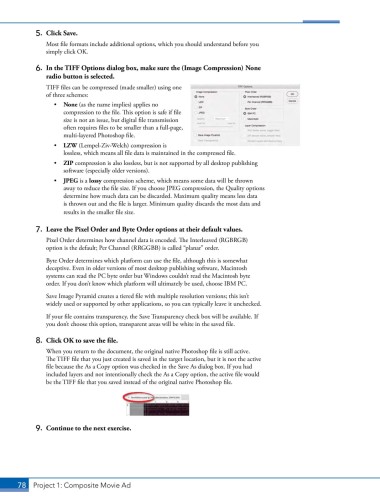
            6.  In the TIFF Options dialog box, make sure the (Image Compression) None
               radio button is selected.
               TIFF files can be compressed (made smaller) using one
               of three schemes:
                  •  None (as the name implies) applies no
                     compression to the file. This option is safe if file
                     size is not an issue, but digital file transmission
                     often requires files to be smaller than a full-page,
                     multi-layered Photoshop file.
                  •  LZW (Lempel-Ziv-Welch) compression is
                     lossless, which means all file data is maintained in the compressed file.
                  •  ZIP compression is also lossless, but is not supported by all desktop publishing
                     software (especially older versions).
                  •  JPEG is a lossy compression scheme, which means some data will be thrown
                     away to reduce the file size. If you choose JPEG compression, the Quality options
                     determine how much data can be discarded. Maximum quality means less data
                     is thrown out and the file is larger. Minimum quality discards the most data and
                     results in the smaller file size.

            7.  Leave the Pixel Order and Byte Order options at their default values.
               Pixel Order determines how channel data is encoded. The Interleaved (RGBRGB)
               option is the default; Per Channel (RRGGBB) is called “planar” order.
               Byte Order determines which platform can use the file, although this is somewhat
               deceptive. Even in older versions of most desktop publishing software, Macintosh
               systems can read the PC byte order but Windows couldn’t read the Macintosh byte
               order. If you don’t know which platform will ultimately be used, choose IBM PC.
               Save Image Pyramid creates a tiered file with multiple resolution versions; this isn’t
               widely used or supported by other applications, so you can typically leave it unchecked.
               If your file contains transparency, the Save Transparency check box will be available. If
               you don’t choose this option, transparent areas will be white in the saved file.


            8.  Click OK to save the file.
               When you return to the document, the original native Photoshop file is still active.
               The TIFF file that you just created is saved in the target location, but it is not the active
               file because the As a Copy option was checked in the Save As dialog box. If you had
               included layers and not intentionally check the As a Copy option, the active file would
               be the TIFF file that you saved instead of the original native Photoshop file.


            9.  Continue to the next exercise.


       78 Project 1: Composite Movie Ad

