


Page 49 - Adobe Photoshop and Dreamviewer 2021
P. 49
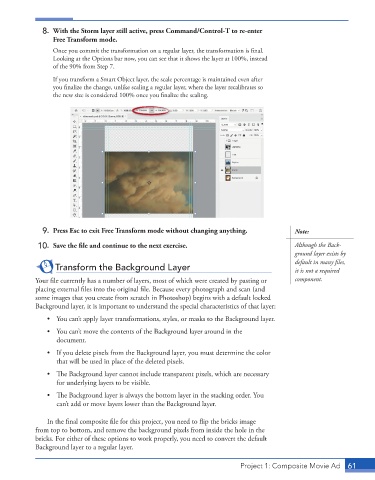
8.  With the Storm layer still active, press Command/Control-T to re-enter
                 Free Transform mode.
                 Once you commit the transformation on a regular layer, the transformation is final.

                 Looking at the Options bar now, you can see that it shows the layer at 100%, instead
                 of the 90% from Step 7.
                 If you transform a Smart Object layer, the scale percentage is maintained even after

                 you finalize the change, unlike scaling a regular layer, where the layer recalibrates so

                 the new size is considered 100% once you finalize the scaling.


             9.  Press Esc to exit Free Transform mode without changing anything.          Note:

             10.  Save the fi le and continue to the next exercise.                        Although the Back-
                                                                                           ground layer exists by

                                                                                           default in many files,
                  Transform the Background Layer                                           it is not a required
            Your file currently has a number of layers, most of which were created by pasting or   component.


            placing external files into the original file. Because every photograph and scan (and
            some images that you create from scratch in Photoshop) begins with a default locked
            Background layer, it is important to understand the special characteristics of that layer:
               •  You can’t apply layer transformations, styles, or masks to the Background layer.
               •  You can’t move the contents of the Background layer around in the
                  document.
               •  If you delete pixels from the Background layer, you must determine the color
                  that will be used in place of the deleted pixels.

               •  The Background layer cannot include transparent pixels, which are necessary
                  for underlying layers to be visible.
               •  The Background layer is always the bottom layer in the stacking order. You

                  can’t add or move layers lower than the Background layer.

               In the final composite file for this project, you need to flip the bricks image


            from top to bottom, and remove the background pixels from inside the hole in the
            bricks. For either of these options to work properly, you need to convert the default
            Background layer to a regular layer.

                                                                          Project 1: Composite Movie Ad    61

