


Page 60 - CS6_PS_Look_Inside
P. 60
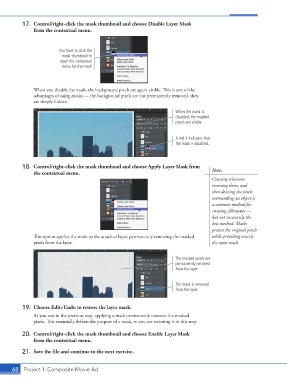
17.  Control/right-click the mask thumbnail and choose Disable Layer Mask
                    from the contextual menu.


                               You have to click the
                                mask thumbnail to
                               open the contextual
                                menu for the mask.


                    When you disable the mask, the background pixels are again visible. This is one of the
                    advantages of using masks — the background pixels are not permanently removed, they
                    are simply hidden.

                                                                              When the mask is
                                                                              disabled, the masked
                                                                              pixels are visible.


                                                                              A red X indicates that
                                                                              the mask is disabled.


                18.  Control/right-click the mask thumbnail and choose Apply Layer Mask from   Note:
                    the contextual menu.
                                                                                             Creating selections,
                                                                                             reversing them, and
                                                                                             then deleting the pixels
                                                                                             surrounding an object is
                                                                                             a common method for
                                                                                             creating silhouettes —
                                                                                             but not necessarily the
                                                                                             best method. Masks
                                                                                             protect the original pixels
                    This option applies the mask to the attached layer, permanently removing the masked   while providing exactly
                    pixels from the layer.                                                   the same result.


                                                                              The masked pixels are
                                                                              permanently removed
                                                                              from the layer.

                                                                              The mask is removed
                                                                              from the layer.


                19.  Choose Edit>Undo to restore the layer mask.
                    As you saw in the previous step, applying a mask permanently removes the masked
                    pixels. This essentially defeats the purpose of a mask, so you are restoring it in this step.

                20.  Control/right-click the mask thumbnail and choose Enable Layer Mask
                    from the contextual menu.
                21.  Save the file and continue to the next exercise.


           68 Project 1: Composite Movie Ad

