


Page 61 - Adobe Photoshop 2022
P. 61
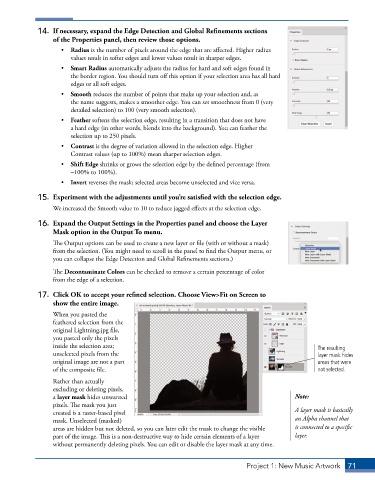
14.  If necessary, expand the Edge Detection and Global Refinements sections
                 of the Properties panel, then review those options.
                    •  Radius is the number of pixels around the edge that are affected. Higher radius
                       values result in softer edges and lower values result in sharper edges.
                    •  Smart Radius automatically adjusts the radius for hard and soft edges found in
                       the border region. You should turn off this option if your selection area has all hard
                       edges or all soft edges.
                    •  Smooth reduces the number of points that make up your selection and, as
                       the name suggests, makes a smoother edge. You can set smoothness from 0 (very
                       detailed selection) to 100 (very smooth selection).
                    •  Feather softens the selection edge, resulting in a transition that does not have
                       a hard edge (in other words, blends into the background). You can feather the
                       selection up to 250 pixels.
                    •  Contrast is the degree of variation allowed in the selection edge. Higher
                       Contrast values (up to 100%) mean sharper selection edges.
                    •  Shift Edge shrinks or grows the selection edge by the defined percentage (from
                       –100% to 100%).
                    •  Invert reverses the mask; selected areas become unselected and vice versa.

             15.  Experiment with the adjustments until you’re satisfied with the selection edge.
                 We increased the Smooth value to 10 to reduce jagged effects at the selection edge.

             16.  Expand the Output Settings in the Properties panel and choose the Layer
                 Mask option in the Output To menu.

                 The Output options can be used to create a new layer or file (with or without a mask)
                 from the selection. (You might need to scroll in the panel to find the Output menu, or
                 you can collapse the Edge Detection and Global Refinements sections.)

                 The Decontaminate Colors can be checked to remove a certain percentage of color
                 from the edge of a selection.

             17.  Click OK to accept your refined selection. Choose View>Fit on Screen to
                 show the entire image.
                 When you pasted the
                 feathered selection from the
                 original Lightning.jpg file,
                 you pasted only the pixels
                 inside the selection area;                                                       The resulting
                 unselected pixels from the                                                       layer mask hides
                 original image are not a part                                                    areas that were
                 of the composite file.                                                           not selected.
                 Rather than actually
                 excluding or deleting pixels,
                 a layer mask hides unwanted                                               Note:
                 pixels. The mask you just
                 created is a raster-based pixel                                           A layer mask is basically
                 mask. Unselected (masked)                                                 an Alpha channel that
                 areas are hidden but not deleted, so you can later edit the mask to change the visible   is connected to a specific
                 part of the image. This is a non-destructive way to hide certain elements of a layer   layer.
                 without permanently deleting pixels. You can edit or disable the layer mask at any time.


                                                                            Project 1: New Music Artwork   71

