


Page 45 - CC2017_ID_Look_Inside
P. 45
Creating Irregular Shapes with the Polygon Tool
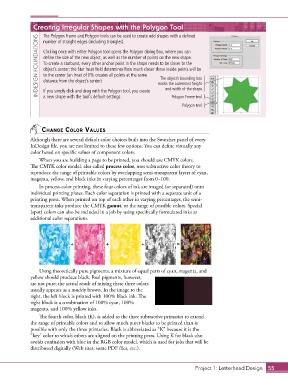
                   The Polygon Frame and Polygon tools can be used to create odd shapes with a defined
                 INDESIGN FOUNDATIONS  Clicking once with either Polygon tool opens the Polygon dialog box, where you can
                   number of straight edges (including triangles).


                   define the size of the new object, as well as the number of points on the new shape.
                   To create a starburst, every other anchor point in the shape needs to be closer to the
                   object’s center; the Star Inset field determines how much closer those inside points will be
                   to the center (an inset of 0% creates all points at the same
                                                                   The object’s bounding box
                   distance from the object’s center).
                                                                  marks the outermost height
                                                                     and width of the shape.
                   If you simply click and drag with the Polygon tool, you create
                   a new shape with the tool’s default settings.
                                                                        Polygon Frame tool
                                                                            Polygon tool


                  ChAnge Color VAlues
              Although there are several default color choices built into the Swatches panel of every
              InDesign file, you are not limited to these few options. You can define virtually any
              color based on specific values of component colors.
                 When you are building a page to be printed, you should use CMYK colors.
              The CMYK color model, also called process color, uses subtractive color theory to
              reproduce the range of printable colors by overlapping semi-transparent layers of cyan,
              magenta, yellow, and black inks in varying percentages from 0–100.
                 In process-color printing, these four colors of ink are imaged (or separated) onto
              individual printing plates. Each color separation is printed with a separate unit of a
              printing press. When printed on top of each other in varying percentages, the semi-
              transparent inks produce the CMYK gamut, or the range of possible colors. Special
              (spot) colors can also be included in a job by using specifically formulated inks as
              additional color separations.


                              +              +             +              =


                 Using theoretically pure pigments, a mixture of equal parts of cyan, magenta, and
              yellow should produce black. Real pigments, however,
              are not pure; the actual result of mixing these three colors
              usually appears as a muddy brown. In the image to the
              right, the left block is printed with 100% black ink. The
              right block is a combination of 100% cyan, 100%
              magenta, and 100% yellow inks.
                 The fourth color, black (K), is added to the three subtractive primaries to extend
              the range of printable colors and to allow much purer blacks to be printed than is
              possible with only the three primaries. Black is abbreviated as “K” because it is the
              “key” color to which others are aligned on the printing press. Using K for black also
              avoids confusion with blue in the RGB color model, which is used for jobs that will be
              distributed digitally (Web sites, some PDF files, etc.).


                                                                                  Project 1: Letterhead Design  55

