


Page 77 - CC2017_PS_Look_Inside
P. 77
8.  Leave the Pixel Order radio button at the default value, and choose the
                   Byte Order option for your operating system.

                   Pixel Order determines how channel data is encoded. The Interleaved (RGBRGB)
                   option is the default; Per Channel (RRGGBB) is called “planar” order.    Note:
                                                                                            Some experts argue that
                   Byte Order determines which platform can use the file, although this is somewhat
                   deceptive. On older versions of most desktop-publishing software, Macintosh systems   choosing the order for
                   can read the PC byte order but Windows couldn’t read the Macintosh byte order —   your system can improve
                   which is why even the Macintosh system defaults to the IBM PC option. This option is   print quality, especially
                   becoming obsolete because most newer software can read either byte order.   on desktop output
                                                                                            devices.
                   Save Image Pyramid creates a tiered file with multiple resolution versions; this isn’t
                   widely used or supported by other applications, so you can typically leave it unchecked.

                   If your file contains transparency, the Save Transparency check box will be available. If
                   you don’t choose this option, transparent areas will be white in the saved file.

                9.  In the Layer Compression area, make sure the RLE option is selected.

                   These three options explain — right in the dialog box — what they do.

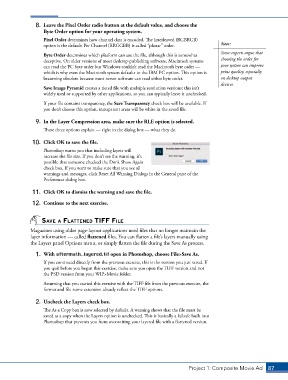
               10.  Click OK to save the file.
                   Photoshop warns you that including layers will
                   increase the file size. If you don’t see the warning, it’s
                   possible that someone checked the Don’t Show Again
                   check box. If you want to make sure that you see all
                   warnings and messages, click Reset All Warning Dialogs in the General pane of the
                   Preferences dialog box.

               11.  Click OK to dismiss the warning and save the file.

               12.  Continue to the next exercise.


                  sAVe A FlAttened tiFF File
              Magazines using older page-layout applications need files that no longer maintain the
              layer information — called flattened files. You can flatten a file’s layers manually using
              the Layers panel Options menu, or simply flatten the file during the Save As process.

                1.  With aftermath_layered.tif open in Photoshop, choose File>Save As.
                   If you continued directly from the previous exercise, this is the version you just saved. If
                   you quit before you began this exercise, make sure you open the TIFF version and not
                   the PSD version from your WIP>Movie folder.
                   Assuming that you started this exercise with the TIFF file from the previous exercise, the
                   format and file name extension already reflect the TIFF options.

                2.  Uncheck the Layers check box.
                   The As a Copy box is now selected by default. A warning shows that the file must be
                   saved as a copy when the Layers option is unchecked. This is basically a failsafe built into
                   Photoshop that prevents you from overwriting your layered file with a flattened version.


                                                                               Project 1: Composite Movie Ad    87

