


Page 70 - Web Combo 2022
P. 70
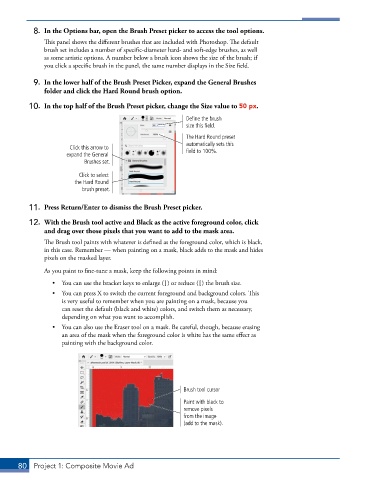
8.  In the Options bar, open the Brush Preset picker to access the tool options.
               This panel shows the different brushes that are included with Photoshop. The default
               brush set includes a number of specific-diameter hard- and soft-edge brushes, as well
               as some artistic options. A number below a brush icon shows the size of the brush; if
               you click a specific brush in the panel, the same number displays in the Size field.

           9.  In the lower half of the Brush Preset Picker, expand the General Brushes
               folder and click the Hard Round brush option.

          10.  In the top half of the Brush Preset picker, change the Size value to 50 px.

                                                          Define the brush
                                                          size this field.
                                                          The Hard Round preset
                                                          automatically sets this
                      Click this arrow to
                     expand the General                   field to 100%.
                           Brushes set.

                         Click to select
                        the Hard Round
                          brush preset.


          11.  Press Return/Enter to dismiss the Brush Preset picker.

          12.  With the Brush tool active and Black as the active foreground color, click
               and drag over those pixels that you want to add to the mask area.
               The Brush tool paints with whatever is defined as the foreground color, which is black,
               in this case. Remember — when painting on a mask, black adds to the mask and hides
               pixels on the masked layer.

               As you paint to fine-tune a mask, keep the following points in mind:
                 •  You can use the bracket keys to enlarge (]) or reduce ([) the brush size.
                 •  You can press X to switch the current foreground and background colors. This
                    is very useful to remember when you are painting on a mask, because you
                    can reset the default (black and white) colors, and switch them as necessary,
                    depending on what you want to accomplish.
                 •  You can also use the Eraser tool on a mask. Be careful, though, because erasing
                    an area of the mask when the foreground color is white has the same effect as
                    painting with the background color.


                                                         Brush tool cursor
                                                         Paint with black to
                                                         remove pixels
                                                         from the image
                                                         (add to the mask).


       80  Project 1: Composite Movie Ad

